How Taekwondo Became Taekwondo 1
The Traces of Okinawa in the Names Tang Soo Do and Kong Soo Do
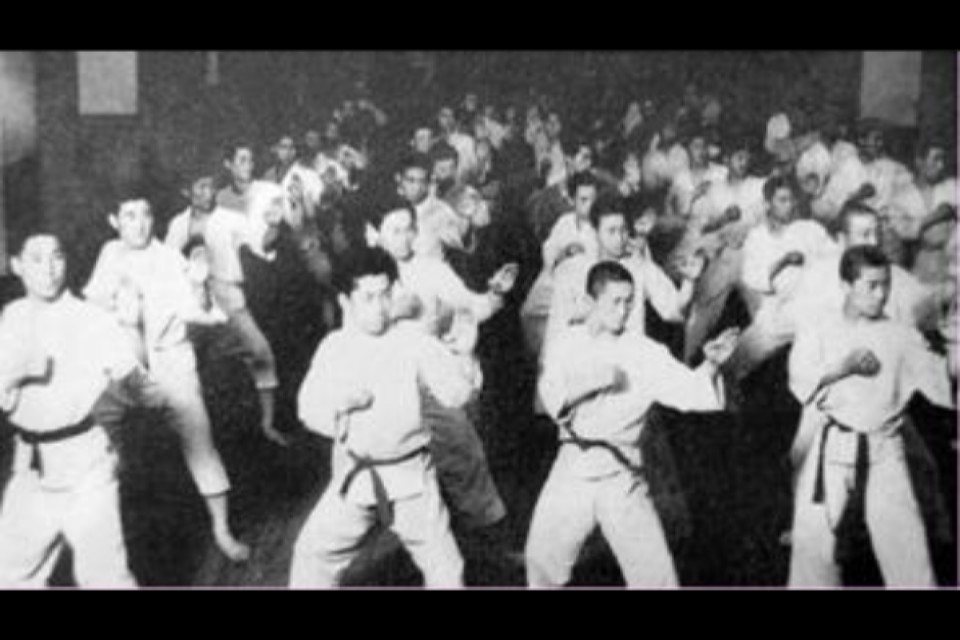
The name Taekwondo did not appear overnight. Before it became established, Korean dojangs used names such as Tang Soo Do and Kong Soo Do. Follow those names, and you will see Okinawa’s 唐手(당수), mainland Japan’s 空手(공수), and the name Taekwondo that Korea’s martial arts community put forward after liberation.
The Unfamiliar Name Tang Soo Do
Today, Taekwondo is the martial art that represents Korea. It is also an Olympic sport and one taught in dojangs (도장), or martial arts training halls, around the world. That can make the name Taekwondo feel as though it has existed for a very long time.
Yet Korea’s martial arts scene in the years immediately after liberation looked very different. Dojangs used names such as Tang Soo Do, Kong Soo Do, and Kwon Bop (권법), literally “fist method,” side by side. These names may sound unfamiliar today, but they preserve traces of early Taekwondo.
Among them, Tang Soo Do is especially important. It is written with the Chinese characters 唐手道(당수도). 唐(당) refers to the Tang dynasty, 手(수) means “hand,” and 道(도) means a way or path of training. Taken literally, the name can be read as “the way of learning the Tang dynasty’s hand techniques.”
But the term did not suddenly originate on the Korean Peninsula. The name Tang Soo Do is connected to an older way of writing Okinawan karate. To understand Taekwondo’s early history, we first need to look at Okinawa.
Okinawa, the Home of Karate
Today, Okinawa is known as a prefecture in southern Japan. Many people associate it with beautiful seas and resort destinations, U.S. military bases, and the home of karate. But Okinawa’s history cannot simply be treated as part of the same story as mainland Japan’s.
Okinawa was once home to the Ryukyu Kingdom. It was a country that traded along sea routes linking several surrounding regions. It was a distinct country with its own royal court, language, culture, and diplomatic order.
The Ryukyu Kingdom’s incorporation into Japan was far from a voluntary choice. In 1879, Japan’s Meiji government deployed police and troops to dissolve the kingdom and establish Okinawa Prefecture. This event is commonly called the Ryukyu Disposition. The word disposition may sound like an administrative procedure, but in practice it meant the end of a kingdom.
Seeing Okinawa simply as one region of Japan causes us to miss this context. It became a Japanese prefecture in legal terms, but Okinawans had a language and culture distinct from those of mainland Japan. In the years that followed, they faced intense pressure to adopt mainland ways of life and standard Japanese.
Of course, it would be difficult to describe Okinawa as a colony in exactly the same way as Korea or Taiwan, because its legal status was different. Yet it would also be inaccurate to say that Okinawa stood in the same position as mainland Japan. Its modern history was deeply marked by forced annexation, discrimination, pressure to assimilate, and colonial-style rule.
This background matters when we try to understand karate. Karate did not emerge directly from an old samurai martial art of mainland Japan. It was a martial art passed down within the Ryukyu Kingdom and among the people of Okinawa.
One word that often appears in discussions of karate’s older roots is te. The word means “hand.” Okinawan te gradually changed as it encountered martial arts brought across the sea, and it later became a foundation of karate.
From 唐手(당수) to 空手(공수)
One of the old ways of writing karate was 唐手(당수). The term later came to be read in Japanese as karate. Here, 唐(당) refers to the Tang dynasty. The name carried a sense of something brought in from beyond Okinawa, or of techniques that came from elsewhere.
In the early twentieth century, this Okinawan martial art entered school education and became more widely practiced. It then reached mainland Japan in the 1920s. A central figure in this story was Gichin Funakoshi, who was from Okinawa. He demonstrated Okinawan martial arts in Tokyo and later taught karate at universities and through various organizations.
To people on mainland Japan at the time, karate was unfamiliar. Judo and kendo were already established within mainland Japan’s martial arts culture, while karate had come from Okinawa. Even within Japan, it may at first have seemed like a system of techniques from somewhere else.
As karate spread across mainland Japan, its written form changed as well. The older 唐手(당수) was gradually standardized as 空手(공수). 空(공) means “empty.” The new spelling emphasized the idea of an empty hand—a hand holding no weapon.
This was more than a change of characters. It was part of the process by which a regional Okinawan martial art was incorporated into mainland Japan’s martial arts institutions. Karate had come from Okinawa, but during this period it became established as one of Japan’s martial arts.
In Korean, the Names Split into Dangsu and Gongsu
In Japanese, both 唐手(당수) and 空手(공수) could be read as karate. Although the characters were different, the pronunciation stayed the same or nearly so. The spelling could change while the word still sounded like karate.
Korean worked differently. In Korean readings of Chinese characters, the two spellings are pronounced dangsu and gongsu.
A term that remained karate in Japanese therefore separated into two names in Korean: dangsu and gongsu. This is why Tang Soo Do and Kong Soo Do could both be used in Korea’s martial arts community after liberation.
Names carry the paths they have traveled. Looking at what a martial art was called can offer clues about where it came from and where it went. The fact that 唐手(당수) survived in Korea as Tang Soo Do shows that an older spelling of Okinawan karate left its mark on the Korean Peninsula as well.
Tang Soo Do was not a name that arose by chance. It holds the story of a martial art moving from Okinawa to mainland Japan and then to Korea after liberation.
Different Names on the Dojang Signs
In 1945, Korea was liberated from Japanese colonial rule. Liberation, however, did not make everything new overnight. The techniques people had learned through practice, the training methods taught in schools and the military, and the martial arts people had learned while studying in Japan all remained.
After liberation, numerous martial arts dojangs appeared in Korea. The term kwan (관) is used for these dojang lineages. A kwan does not refer to a single training hall; it means a lineage or martial arts organization connected through the same teacher, training system, and tradition.
Discussions of early Taekwondo often refer to the five major kwans (5대관). Sources differ somewhat over their names and scope, but Chung Do Kwan, Song Moo Kwan, Moo Duk Kwan, Chosun Yun Moo Kwan, and the YMCA Kwon Bop Department are often included.
The major kwans did not all use the single name Taekwondo from the beginning. Some called their art Tang Soo Do, some Kong Soo Do, and others chose Kwon Bop. Before Korea’s representative martial art came to be known as Taekwondo, several different names hung side by side across its martial arts community.
Of course, these dojangs were not all identical. Their founders’ experiences differed. Some had studied karate in Japan, some said they had learned Kwon Bop in other regions, and others emphasized ties to traditional Korean martial arts.
Even so, comparisons of early documents and techniques show that the influence of karate remained strong within Korean martial arts just after liberation. Some research has found particularly clear traces connecting early Korean martial arts to Gichin Funakoshi’s Shotokan karate. Recognizing this relationship gives early Taekwondo a clearer shape. Taekwondo did not emerge as a fully independent system from the outset. It began through a process of taking in existing martial arts and giving them new names.
Syngman Rhee Was Reminded of Taekkyeon
How, then, did the name Taekwondo move to the forefront? The story involves Syngman Rhee, the first president of the Republic of Korea, and Taekkyeon (태껸, also written 택견).
One story often mentioned in discussions of Taekwondo’s name says that, after watching a military martial arts demonstration in the 1950s, Rhee was reminded of Taekkyeon. Taekkyeon is a traditional Korean martial art known for its fluid, rhythmic movements and kicking techniques. It also includes techniques for kicking or taking an opponent down.
This story matters because Taekwondo was not merely a name for a set of techniques. In post-liberation Korean society, there was a desire to give the martial art a more Korean name. Japanese-style names and names with a distinctly foreign ring were bound to feel uncomfortable.
A clear distinction is needed here. The story that Rhee thought of Taekkyeon does not mean that Taekkyeon was the technical root of early Taekwondo. Early Taekwondo’s technical system was far closer to Tang Soo Do, Kong Soo Do, and Shotokan karate.
In this article, then, it is more accurate to see Taekkyeon not as a direct technical ancestor, but as part of the symbolic background that helped the name Taekwondo acquire a Korean resonance.
Coming Together Under the Name Taekwondo
In the 1950s, some figures actively promoted the name Taekwondo. The most frequently mentioned is Choi Hong Hi, who taught martial arts in the military. He believed that Taekwondo was a more fitting name for a Korean martial art than Tang Soo Do or Kong Soo Do.
The name Taekwondo contains 跆(태), 拳(권), and 道(도). 跆(태) evokes stepping or kicking with the foot, 拳(권) means “fist,” and 道(도) adds the idea of a path of training. Taken literally, the name evokes kicking and punching more clearly than hand techniques.
But the terminology was not unified at once. Names including Tang Soo Do, Kong Soo Do, Kwon Bop, Soo Bahk Do, and Taekwondo continued to be used alongside one another for a time. The kwans had their own interests, and they also differed over how the martial art should be described.
In 1961, amid efforts to bring the different schools together, the name Korea Taesoodo Association (대한태수도협회) was adopted. Taesoodo is written 跆手道(태수도). Here, 跆(태) suggests kicking with the foot, while 手(수) suggests the hand. The name conveyed the image of a martial art using both hands and feet.
The name did not last long. In 1965, the association was renamed the Korea Taekwondo Association (대한태권도협회). From then on, Taekwondo moved to the foreground, while Tang Soo Do and Kong Soo Do gradually receded.
Changing a name is not simply a matter of replacing a sign. It also means deciding which history to place in front and which traces to leave behind. By choosing the name Taekwondo, Korea’s post-liberation martial arts community sought to move away from Japanese-style and foreign-sounding names.
Kukki Taekwondo and an Uncomfortable Memory
Once the name Taekwondo had taken hold, it acquired a larger meaning: Kukki Taekwondo (국기 태권도). Here, kukki means an art or discipline that represents the nation.
In 1971, President Park Chung-hee left a calligraphic inscription reading “Kukki Taekwondo.” Taekwondo would not be legally designated Korea’s national martial art until much later, but the inscription became a symbolic moment that led many people to see it that way.
Park’s government gave Taekwondo considerable support. Korea at the time was emphasizing rapid economic growth and national mobilization. The state needed a symbol of a strong body and a resolute spirit. Taekwondo fit those demands well. It could be practiced unarmed, its kicks stood out in demonstrations, and it was well suited to use in the military, schools, and overseas missions.
As Taekwondo became the martial art representing the nation, there was also a perceived need to shape its history into a more distinctly Korean story. The idea that a martial art called Korea’s kukki was deeply connected to karate would have been uncomfortable. Moreover, memories of the Japanese empire were still close at hand in Korean society.
In this climate, traces of Okinawa and karate gradually faded from view. References to ancient Korean martial arts, the Hwarang, and Taekkyeon instead moved to the center of the narrative. There were understandable historical reasons for this. It was natural for a country that had lived through colonial rule to want a national art of its own.
But understandable reasons do not automatically make an account accurate. Traces of Okinawan karate and Shotokan karate remained in Taekwondo’s early names and techniques. If those traces are erased entirely, we miss the process through which Taekwondo actually took shape.
The Question That Remained After the Name
The names Tang Soo Do and Kong Soo Do gradually moved into the background. The transitional name Taesoodo did not last long either. In the end, Taekwondo became the name representing Korea’s martial arts community.
But gaining a name did not mean that the Taekwondo we know today was immediately complete. The name was only the beginning. Techniques still had to be organized, dojangs and associations unified, and competition rules created. Another major question was whether it would remain a martial art within Korea or grow into a sport learned around the world.
The name Tang Soo Do is a doorway into the question of where Taekwondo came from. Open it, and the Ryukyu Kingdom, Okinawan karate, Shotokan on mainland Japan, Korea’s post-liberation dojangs, and the name Taekwondo put forward by Korea’s martial arts community appear one after another.
But another question remains.
How did Taekwondo become a martial art distinct from karate?
That story continues in the next part.
- Park Hanbin