Monami 153: Why Korea’s White Ballpoint Pen Still Matters
How a 15-won ballpoint pen stayed in Korean hands—and helped shape the Monami of today
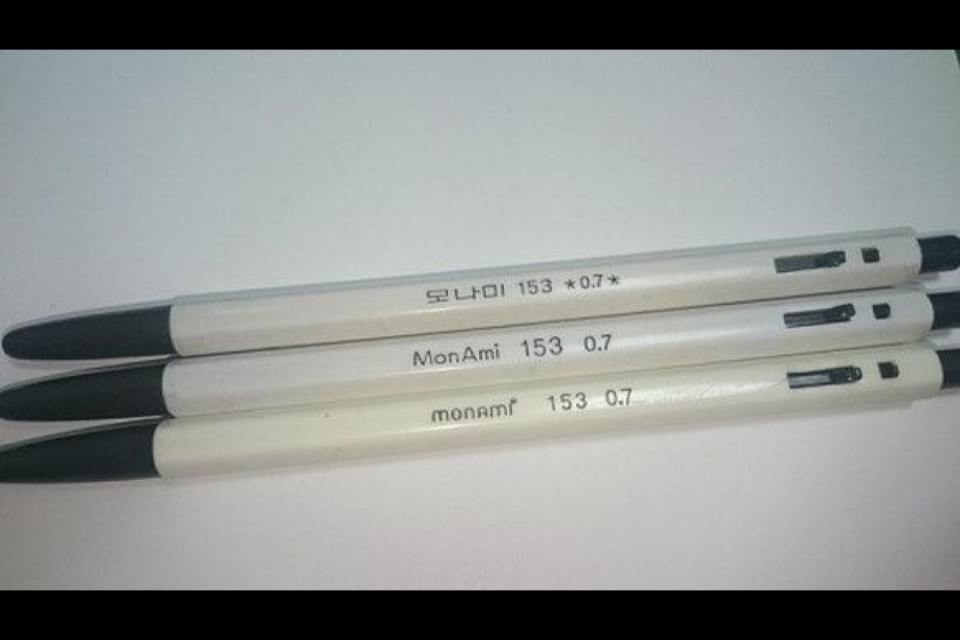
A white body, a black top, and the number 153 on the side. This pen, often found on Korean desks without anyone asking who bought it, remains the oldest and most familiar face of Monami.
The Pen That Was Always on the Desk
Anyone who has spent time in a Korean school or office will recognize a certain ballpoint pen. A white body, a black top. It is hexagonal rather than round in the hand, with the number 153 printed on the side. Even fresh out of the package, it somehow looks like something you have known for years.
That pen is the Monami 153. For people in Korea, the 153 was not something that needed much explanation. It was the pen they reached for when writing their name on a test, dating a document at work, signing something at a store counter, or quickly taking notes during a phone call.
There was usually one on a desk, even if no one knew who had bought it. One sat beside the telephone at home, in a drawer at the school office, or at a bank counter. That is why the 153 is often described as Korea’s everyday ballpoint pen. This does not mean it was officially designated by the state. Rather, so many people used it for so long that it gradually came to represent everyday writing in Korea.
Here, stationery means the pens, pencils, notebooks, and other items people use for study or work. Monami is one of Korea’s best-known stationery companies, and the 153 is the product most closely associated with its name. It is almost quicker to show someone this single white ballpoint pen than to explain the company first.
From Desks with Ink Bottles
Monami was originally called Kwangshin Chemicals. Founded in 1960, it initially made art supplies. The name Monami comes from the French phrase mon ami, meaning “my friend.”
In the early 1960s, ballpoint pens were not yet something people in Korea took for granted. People were accustomed to keeping an ink bottle on the desk and dipping a nib into it to write. Writing required preparation, and leaking or spilled ink could cause trouble. Simply picking up a pen and writing immediately, as people do now, was not yet common.
At an international industrial fair in 1962, founder Song Sam-seok saw a writing instrument that could be used without dipping it in ink. Perhaps Korean desks were the first thing that came to mind: a pen that needed no ink bottle, could be carried in a bag with less worry, and was affordable for almost anyone. He spent about a year researching ink, and the Monami 153 was released in 1963. Monami describes it as Korea’s first ballpoint pen.
It did not earn people’s trust from the start. Early versions sometimes leaked ink onto clothing. Stories are still told of the company having to pay for customers’ stained dress shirts. People were understandably reluctant to trust the new pen when they already had writing tools they knew well.
Monami employees visited government offices, banks, and corporate offices. They invited people to try the ballpoint pen and fixed the problems users pointed out. They revised it, then went back and asked people to try it again. Even an object that seems completely ordinary in hindsight once had to persuade people to use it.
The same was true of the 153. A low price did not make it sell itself. It had to win people over one by one, convincing them that an inexpensive pen could still be dependable.
The Number 153
There is little attempt at flair in the product name 153. The most widely told explanation is simple: 15 refers to its launch price of 15 won, while 3 means it was the third product Monami made.
A 15-won ballpoint pen, the company’s third product. Even the name is stripped of ornament. That suits the product itself. This was not an expensive pen to keep carefully on display, but one to take out whenever it was needed. Losing it would be a shame, but not something to worry about all day. The number 153 carries something of that era’s practicality.
Another interpretation is sometimes mentioned. In the Gospel of John, Peter catches 153 fish. One explanation says the founder associated the number with abundance and trust. Still, perhaps the main reason people came to remember 153 is simply that they kept seeing the number in everyday life.
Some names last because they sound stylish; others because people become used to saying them. The 153 is closer to the latter. It became a product name despite being a number, and in people’s memories, that name survives almost like a visual shape.
Affordable, Not Cheaply Made
The 153 was an inexpensive ballpoint pen. That did not make it a shoddy one. Calling something “cheap” can suggest that it was carelessly made, but the 153 was closer to the opposite. As an everyday object should, it quietly did its job.
There is a reason for its hexagonal barrel, too. A round pen easily rolls off a desk. A hexagonal body rests more securely and is less likely to slip in the hand. The contrast between the white body and black top is also clear. Even from a distance, it is easy to recognize as “that pen.”
Its construction is not complicated: the barrel, top, push button, spring, and refill. The basic parts are simply where they need to be. It is easy to mass-produce, easy to keep affordable, and easy to get used to. For an everyday object, that kind of simplicity is a major strength.
According to Monami, about 4.3 billion 153 ballpoint pens had been sold in Korea and abroad as of 2021. Sales alone cannot prove that a product is good. Still, one thing can be said: people do not keep buying the same object again and again for no reason.
The 153 was never a pen loved with much fanfare. It was there when needed, usually worked when picked up, and could be replaced when lost. This is sometimes how trust in an everyday object builds: quietly.
So Familiar It Became New Again
Objects that remain commonplace for a long time acquire a peculiar power. At first, they seem too ordinary for anyone to find them special. With time, the story changes. Their ordinary shape begins to carry memories with it. The white body and black top of the 153 can bring back scenes of school test papers, office desks, old drawers, or a parent’s pencil case.
Monami brought that familiar face back into view. In 2014, it released premium pens such as the 153 Limited, 153 ID, and 153 Respect. The basic look of the original 153 remained, while metal bodies, premium refills, new colors, and different finishes were added.
From then on, the 153 occupied a slightly different place. The old 153 was a pen people borrowed without hesitation and lost without much concern. The premium 153 was closer to a pen deliberately chosen and kept. The face was familiar, but the feeling of holding it had changed.
Products such as the 153 ID fountain pen and the 153 Respect Refine followed. A fountain pen is a slower tool than a ballpoint pen. You fill it with ink and pay attention to the feeling of the nib meeting the paper as you write. Monami’s decision to carry the shape of the 153 into a fountain pen can be read as an attempt to use the face of an old ballpoint to speak again about the pleasure of handwriting.
The Ballpoint Pen That Moved onto the Screen
When brands release a product together, it is called a collaboration—often shortened in Korean to collabo. Monami has collaborated with a number of brands. What stands out here, however, is less the number of collaborations than the way the 153’s familiar form moved onto other objects.
One notable example is the Monami 153 S Pen, created with Samsung Electronics. The S Pen is a digital stylus used with Samsung Galaxy devices. The face of the 153, once used to write on paper, crossed over to smartphone and tablet screens.
Monami also teamed up with the tech-accessory brand elago to make an Apple Pencil case. The Apple Pencil is a digital stylus used with Apple tablets. The case borrowed the 153’s black-and-white palette and the feel of its hexagonal barrel. It was designed to keep the familiar feel of a ballpoint pen in the hand, even while writing on a screen.
The 153 briefly stepped into fashion as well. A collaboration with ADERERROR brought unexpected colors to premium 153 ballpoint pens, while a project with Vans used the 153’s black-and-white imagery on shoes and clothing. There is no need to trace every example in detail. The point is simple: the 153 is no longer only the name of a single ballpoint pen. For one person it is a color scheme; for another, a shape; for another, a sign that calls up old memories.
From a Shared Pen to a Personal One
The old 153 often felt like somebody else’s pen—or perhaps no one’s in particular. No one knew who had bought it or how long it had been there, and no one was especially surprised if it went missing. Schools and offices were full of such pens. The fact that everyone used the same pen was part of the 153’s appeal.
Today, people often want to leave a little trace of themselves even when using the same objects as everyone else. They choose a color, add a name, or engrave a short phrase. In many cases, the feeling that “I chose this” matters more than the object itself.
Monami’s engraving service and made-to-order products speak to that desire. Engraving means carving a name or message into an object. Add your own name, a friend’s name, or a favorite word to a pen, and even an ordinary ballpoint becomes something different.
The Monami 153 Love, for example, carries the phrase “I LOVE ” on its barrel. The blank can be filled with any chosen name or message. The 153 that once might have rolled around on any desk now carries someone’s name and becomes a gift.
This shift is interesting because it moves in the opposite direction from where the pen began. The 153 was originally a mass-produced object designed so that many people could use the same thing affordably and conveniently. Now personal names and tastes are layered onto it. It is finding a way to be everyone’s ballpoint pen and, at the same time, one that feels entirely one’s own.
Choosing a Pen Again
Smartphones have long been part of everyday life. People leave notes on phones, write documents on computers, and store photos in the cloud. There is no shortage of fast and convenient ways to record things.
Yet analog objects do not disappear easily. Some people deliberately seek out slower things. They collect vinyl records, take pictures on film, keep diaries with fountain pens, and decorate paper planners. They choose these objects not because they are convenient, but because of the feeling of using their hands a little more.
Monami’s recent moves point in the same direction. It is not trying to become a fashion label or a gift-goods company. Pens remain at the center. But it no longer presents a pen simply as a tool for putting words on paper. Instead, it presents the pen anew as something to choose, hold, try out, engrave with a name, and even use to create an ink color.
Monami’s concept stores and Ink LAB are part of this shift. In the stores, people hold pens, make their own ink colors, and engrave their names. Buying a single pen becomes a small experience. Even if people write by hand less than before, the pleasure of choosing something by hand has not disappeared.
At first, the 153 was a tool that made life a little less inconvenient: an inexpensive ballpoint pen that let people write without an ink bottle. Over time, it began to tell a story slightly different from convenience. Why do people still want to write by hand? Why go to the trouble of choosing paper and a pen, then pressing letters onto the page?
The answer may not be grand. Writing by hand is slow. Erasing is awkward, and storing pages can be a nuisance. Yet that slowness can make a thought linger a little longer. As the fingertips press down, something of the writer seems to enter the words. Text on a screen passes quickly, while words on paper feel as though they remain somewhere.
The Monami 153 began as a 15-won ballpoint pen. It has since become a premium pen, an S Pen, an Apple Pencil case, and a gift engraved with a name. Yet through that long journey, the same impulse remains at its center: sometimes people want to leave something behind with their own hands. That may be why an old pen can still draw out new stories.
- Park Hanbin