The Shadow-Severing Horse and Cauldron Mountain
A journey through the old stories hidden in Busan’s place names.
Yongsan could be read as “Dragon Mountain,” Suwon as “Water Field,” and Cheonan as “Heavenly Peace.” Cheongju might sound like “Pure City,” Jeonju like “Perfect Area,” Gwangju like “Region of Light,” and Yeosu like “Beautiful Water.” These are not official translations, of course. But once you unpack the names this way, Korea’s place names suddenly look like a map from a fantasy game. Busan is no different. Hidden inside the name of a city known above all for the sea is Cauldron Mountain.
The Fun of Unpacking Place Names
Place names are so familiar that it is easy to pass over them. We see them on maps, hear them at subway stations, and write them in addresses. In time, we rarely stop to wonder where the words came from or what scenes they hold.
Sometimes a landscape changes simply because we read its name a little differently. Some names contain mountains; others, water. They also hold light, peace, wind, and the hopes of people long ago. We do not have to settle on an academically precise etymology. Simply unpacking a name can make a familiar place feel like an unfamiliar story.
This article is not an attempt to find the single right answer behind each place name. Some stories are closer to the historical record; others, to legend. Rather than draw a strict line between them, we will follow the scenes the names bring to mind.
Busan is an ideal place to begin. The city is famous for the sea. Yet there is no sea in its name. There is a cauldron and a mountain instead.
Busan Boils Like a Cauldron
The name Busan carries the meanings “cauldron” and “mountain.” It is commonly explained as coming from a mountain shaped like a cauldron. Read playfully in English, it becomes Cauldron Mountain.
A cauldron is a vessel in which many ingredients boil together. Water, meat, vegetables, and seasoning go in separately, but over time they become one dish. Busan is something like that. Ships come and go through the port, carrying people, goods, and languages. People from elsewhere in Korea, travelers from other countries, old alleyways, and newly opened shops all mingle within one city.
Today, Busan is welcoming more international visitors and migrants. Tourism statistics show a rapid rise in visitors from abroad, while more languages can be heard on the streets than before. A city long connected to the wider world across the sea is still a place where new people arrive.
Cauldron Mountain suits Busan surprisingly well. Rather than a city standing quietly still, Busan keeps boiling and blending, producing new flavors. Step into that cauldron and more names await: a grassy hill, a shadow-severing horse, a royal cliff, sea and clouds, a broad and peaceful shore, islands between five and six, and a sacred waterway.
Choryang, a Grassy Hill Seen from a Ship
A trip to Busan usually begins at Busan Station. Step off the train and into the plaza, and the first view is a downtown packed with tall buildings, traffic, and people. Now turn the clock back a little further. Before industrialization began in earnest, someone arriving in Busan from abroad would likely have encountered the sea before the railway station.
A ship moves slowly into the waters off Busan. This is not yet an age of broad roads and rows of port cranes. Through the sea breeze, low hills come into view, with silver grass and other grasses swaying above them. For someone setting foot on unfamiliar land, that green might have lingered as a first impression of the city.
That scene suits the name Choryang. The area is said to have once been grassland thick with silver grass and cogon grass, and that grassy slope came to be called Choryang. Today, the neighborhood is better known for Busan Station, Chinatown, and its old alleys. Yet once you know the name, you can picture the meadow hidden behind the crowded city.
Choryang feels like the first gate into Busan. It is not an ornate one. Instead, it quietly reveals an older face of the city, shaped by sea and hills, grass and wind.
Yeongdo, Island of the Shadow-Severing Horse
Among Busan’s place names, few stories are as vivid as Yeongdo’s. The island is called Yeongdo today, but it was once known as Jeoryeongdo. That older name leads directly to the story of the “shadow-severing horse.”
The story goes like this. Yeongdo was home to horses so fast that even their shadows could not keep up when they ran. How fast would a horse have to be to leave its own shadow behind? Jeoryeongdo can be imagined as “the island where the shadow-severing horse lived.”
One point matters here: it is not the island that severs a shadow. The horse said to have lived there was so swift that it seemed capable of severing its own shadow. In English, the shadow-severing horse captures the feeling. Spelled out more fully, it is a horse that severs its shadow.
Picture the scene. A horse races along a ridge beside the sea. The wind tosses its mane, and the sound of hooves carries across the island. It moves so quickly that it leaves its shadow behind. No such horse can be seen on Yeongdo today. The island is better known for Huinnyeoul Culture Village, the Jeoryeong Coastal Trail, its port and shipyards, and its views of the sea.
Still, once you know the name, Yeongdo’s roads look a little different. Walking beside the sea, you may almost hear hoofbeats somewhere nearby. A name can briefly bring a vanished scene back to life.
Taejongdae, a Cliff Bearing a King’s Name
At the far end of Yeongdo lies Taejongdae. Follow the forest path toward the sea and you reach a landscape where rocky cliffs meet the waves. The sea looks vast from above, and the waves breaking below have a deep, powerful sound.
A royal story is attached to the name Taejongdae. Tradition says that King Taejong Muyeol of Silla passed through this place, and that his name has endured here to the present day. More interesting than determining exactly which rock the king once stood on is the atmosphere his name adds to the landscape.
Standing on the cliff, you naturally look far into the distance. The sea seems endless, and passing ships look small in the distance. The name gives Taejongdae a different kind of weight. It feels not simply like a beautiful coastal cliff, but like the edge of the sea where a king’s name remains.
If Yeongdo has its shadow-severing horse, Taejongdae has the shadow of a king gazing out over distant waters. The two stories are different, yet they flow naturally together on the same island.
Haeundae, Between Sea and Clouds
When people think of the sea in Busan, many picture Haeundae first. A broad beach, high-rises, summer parasols, and lights at night all come to mind at once. The name is so famous that few people stop to think about the word itself.
The place name Haeundae is traditionally linked to Choe Chiwon, a scholar and writer of the Silla kingdom. Choe is said to have used “Haeun” as his ho (호), a name used in addition to one’s given name. It was somewhat like a pen name or nickname today, though it generally carried more gravity. People sometimes used a ho to express their ideas, favorite landscapes, or attitude toward life.
Imagine such a person encountering Busan’s sea. Near Dongbaekseom, there was a rock with a sweeping view of sea and clouds, and he may have paused there for a long time. Perhaps he felt he had found a landscape that suited his ho. The story says he left that feeling behind in the inscription “Haeundae” on the rock.
One person’s ho met a seaside landscape, and the inscription was remembered for generations. Over time, the name moved beyond the person and became the name of a place. Seen this way, Haeundae no longer sounds like just the name of a beach. It feels like a place where someone saw sea and clouds meet and held on to their beauty through his own name.
Today’s Haeundae is thoroughly modern. It has hotels and cafés, a beach train, festivals, and glittering night views. Yet an old exclamation remains inside its name: “This place is beautiful.” Perhaps the name Haeundae has held on to that brief feeling ever since.
Gwangalli, a Wide and Peaceful Night Sea
If Haeundae feels like Busan’s signature daytime coast, Gwangalli is more closely associated with the sea at night. After sunset, Gwangandaegyo Bridge lights up, and its glow stretches and shimmers across the waves. People stroll along the beach, while light from cafés and restaurants spills toward the water.
The name Gwangalli brings together images of a broad shore and a peaceful sea. To understand the story, it helps to know a little about pungsu (풍수). Pungsu is an old way of thinking in which the shape of the land, waterways, directions, dates, and names are believed to affect the fortunes of people or communities. Rather than a system tested through modern science, it is closer to the way people in the past read the relationship between land and life.
Gwangalli is said to have once suited a name meaning “wide shore.” A story then tells of the name shifting, through the lens of pungsu, toward the meaning “wide and peaceful.” Because the area was also associated with coastal defense, the name can be read as a wish for a wide and peaceful sea.
Think of Gwangalli at night, and the phrase feels fitting. The bridge lights spread wide, the sound of the waves repeats, and for a moment the sea seems at peace. If Haeundae is a name of sea and clouds, Gwangalli is a name of breadth and peace. Busan’s two seas are remembered in different ways.
Oryukdo, Five or Six?
The name Oryukdo is intriguing from the start. Five, or six? A name for islands might seem too ambiguous, but that uncertainty is precisely Oryukdo’s charm.
One story says that Oryukdo looked like five peaks from one direction and six from another. Another explanation links the changing number to the tides. That second account should be approached with some caution. The appeal of the name lies less in a fixed number than in the position from which one looks.
The same landscape changes depending on where you stand. Just as Oryukdo looks different from east and west, so does travel itself. Some people notice Busan’s port first; others, the sea. Some see its old stories, while others see cafés and city lights at night.
Oryukdo tells us this in its name. Somewhere between five and six, the landscape changes with the viewer’s position.
Gamcheon, a Village Along a Sacred Waterway
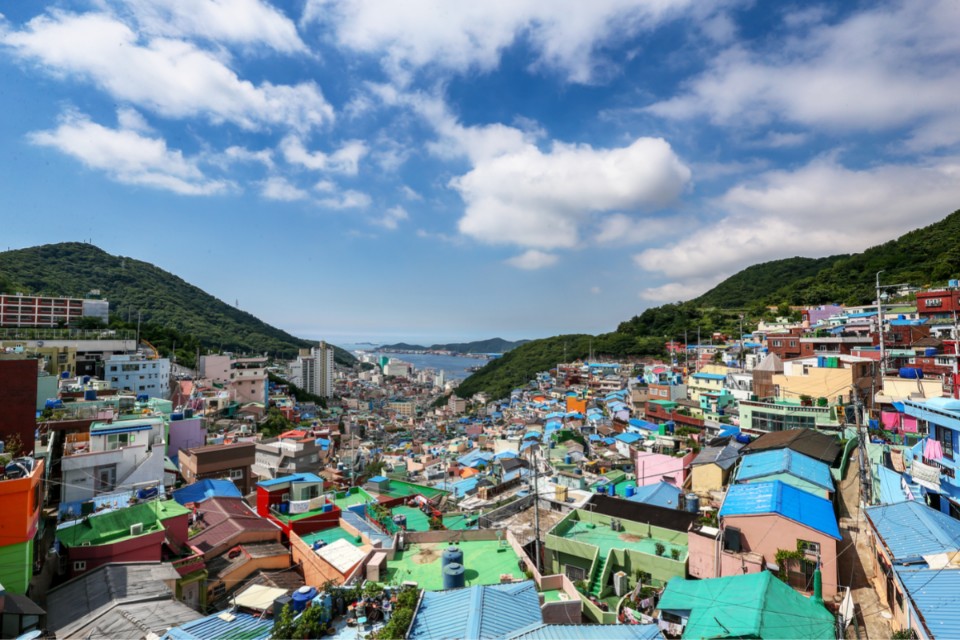
Gamcheon Culture Village is now one of Busan’s best-known attractions. Brightly colored houses climb the hillside, and the sea appears between narrow alleys. For many travelers, Gamcheon is remembered as a village of color.
The name Gamcheon is worth pausing over too. Although the area is called Gamcheon today, it is said to have once been known as Gamnae. In Korean, nae means a stream or waterway—the same nae heard in words for a brook and a stream bank.
There is a story that gam is connected to a sacred being. Read this way, Gamnae sounds less like an ordinary neighborhood with running water and more like a place that holds a special waterway. Waterways are tied to village life as well. People gather to live near water, and water becomes a road, a boundary, and a memory.
Later, the nae in Gamnae was replaced by the Sino-Korean term cheon. The form of the name changed, but the image of flowing water remained. Read Gamcheon anew, and an old waterway seems to run beneath its colorful houses.
Gamcheon today is famous as a photogenic village. But before it became a tourist destination, it was already a place where people made their lives. Its name still holds the image of a sacred waterway running through a place where people built their lives.
When You Know the Names, the Road Looks Different
Korean place names are usually short. In two or three syllables, they name an entire neighborhood, mountain, or stretch of sea. Look slowly into those brief words and more scenes emerge than expected: a grassy hill, a shadow-severing horse, a royal cliff, sea and clouds, a wide and peaceful night sea, islands between five and six, and a sacred waterway.
Busan is Cauldron Mountain. Within it, ports and alleys, beaches and cliffs, tourists and migrants, old stories and new cultures boil together. The name Busan speaks not only of the past. It also evokes the character of a city that continues to mix and change today.
The next time you visit Busan, try reading the names of its places slowly. In Choryang, picture a grassy hill; in Yeongdo, the shadow-severing horse; at Oryukdo, islands whose number seems to waver. In Gamcheon, you might imagine a sacred waterway.
The map stays the same. Yet once you know the names, the road looks a little different. Travel is a way of seeking new places, but it is also a way of rereading names we thought we already knew.
- Park Hanbin