What Does the Apartment Mean to Koreans? Part 1: The Home Everyone Knows
From ROSÉ and Bruno Mars’s “APT.” to pyeong and apartment complexes, how apartments became the everyday standard home in Korea
ROSÉ and Bruno Mars’s “APT.” grew out of a Korean drinking game. That is how familiar the word apartment is in Korea. Inside this ordinary word are people drawn to the cities, complexes built at speed, and an everyday question: “How many pyeong is it?”
The Word That Became a Song: Apartment
To someone learning Korean, apateu (아파트) may look like the Korean pronunciation of apartment. That is true. But in Korea, the word is more than a borrowed term.
The word names a kind of home, and apartments are among the most common sights in Korean cities. It appears in addresses and conversations, and sometimes becomes the name of a drinking game. “APT.,” the song by BLACKPINK’s ROSÉ and Bruno Mars, grew from this familiar word. The song is known to have been inspired by a Korean drinking game called Apartment.
The Apartment game is a simple game adults play while drinking. Players stack their hands in turn, then remove them as they count toward a chosen number. Why is it called Apartment, of all things? Before looking for a deeper reason, consider this: in Korea, the word apartment is so common that it does not sound strange as the name of a game.
When a word can become a game, a song title, and a joke, it has found its way deep into everyday life. In Korea, apartment is less a special word than one people see and say all the time.
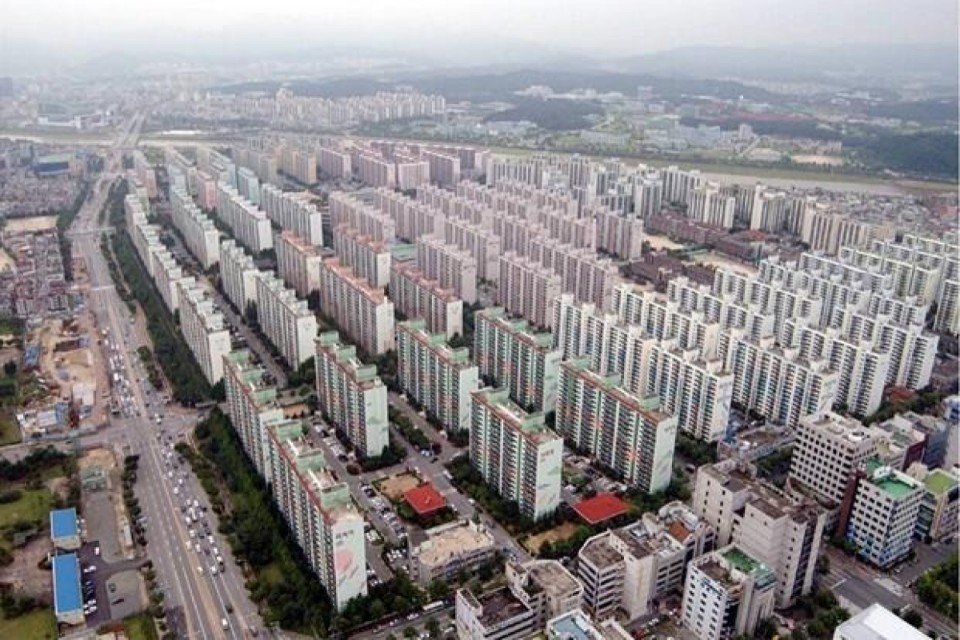
Of course, not everyone in Korea lives in an apartment. Many people live in detached houses, low-rise multifamily homes, officetel units, dormitories, or gosiwon rooms. Still, when many people picture a Korean city, apartments come first. Tall buildings outside a subway window, numbers fixed to each building, playgrounds inside the complex, shops at the entrance—these scenes have become part of everyday life in Korea.
So why did Korean cities become so full of apartments?
Why Did the City Grow Upward?
The rapid growth of apartments was rooted in rapid urbanization. Urbanization is the process by which more people come to live in cities rather than in rural areas.
Korea urbanized rapidly over a short period. Jobs, schools, hospitals, transportation, and cultural facilities concentrated in cities. People moved there too. Seoul and the surrounding capital region, in particular, came to house a very large population.
When many people gather in one place, many homes are needed. Building one house at a time across wide stretches of land could not keep pace. So Korean cities grew upward. A single building held multiple homes, and groups of buildings formed large residential areas.
The numbers also show how large a role apartments play. As of 2024, apartments made up about 65 percent of all homes in Korea. More than half of general households lived in apartments. In the same year, most of Korea’s registered population lived in urban areas, meaning areas administratively classified as urban.
These numbers show that apartments in Korea are more than simply a popular type of home. They have become the basic backdrop of urban life. Large numbers of people moved into cities, and housing had to be provided quickly. In that process, apartments emerged as the most viable option.
Apartments were also a product of preference. Many people wanted clean, convenient homes. At the same time, they were a product of speed. To house a rapidly growing urban population, Korean society needed homes that could be built in large numbers and supplied quickly.
The Apartment Complex as a Small Neighborhood
In Korea, an apartment often means more than a single building. What many people picture is an apartment complex.
A complex is a residential area made up of several apartment buildings. A building is usually labeled with a dong (동) number, and each home with a ho (호) number. That is why Korean addresses often include expressions such as “Building 101, Unit 1203.” It may look like a numerical code at first, but to people in Korea it is a very familiar way of writing an address.
A complex contains more than homes. There are playgrounds, parking areas, walking paths, security posts, and management offices. Some also have small shopping areas, childcare centers, and exercise facilities. Schools are often nearby. So saying “I live in an apartment” points to more than the space inside a home. It also brings to mind a small world of everyday life.
This culture of large complexes became more visible after the 1970s. As Seoul’s Gangnam area was developed, large apartment complexes were built in places such as Banpo and Jamsil. Public institutions first developed large complexes, and private construction companies later moved into apartment construction as well. Before long, apartments were no longer unfamiliar buildings but a defining way of building cities.
For international readers, this difference may feel new. In some countries, apartment strongly suggests a single home within one building. In Korea, the word often carries a broader meaning. An apartment is a home, an address, and a small neighborhood.
The Promise of a Clean, Convenient Home
Apartments did not have a positive image for everyone from the beginning. The idea of several families living together in one building was unfamiliar. It was also different from the long-established life of courtyards and alleys.
Over time, many people came to see apartments as clean and convenient homes. They had indoor toilets and bathrooms, heating in winter, and playgrounds within the complex where children could play. Elevators carried residents to higher floors. Parking areas and nearby shops were another advantage.
Of course, apartments were not always convenient or luxurious. Older apartments came with inconveniences of their own. Even so, to many people at the time, apartment living looked like a path toward a more modern way of life.
Korean ways of living did not disappear completely inside apartments. For a long time, people in Korea had spent much of daily life sitting on or close to the floor. A warm floor was an important condition of a good home. Modern apartments may look like Western-style multiunit housing, but traces of Korean domestic life remain inside. Floor heating is a good example.
A concrete building on the outside, a home with warm floors on the inside. This combination played a major role in making apartments the everyday home in Korea.
“How Many Pyeong Is It?”
One question comes up often when people in Korea talk about homes.
“How many pyeong is it?”
Official documents use square meters, or ㎡. In everyday conversation, however, people still often use pyeong (평), a floor-area unit. Pyeong is not a legal unit of measurement; square meters are the official measure of area. Even so, many people in Korea think in pyeong when talking about the size of a home. One pyeong is approximately 3.3058 square meters.
This can seem a little strange to international readers. Schools teach the metric system, and documents show areas in square meters. Yet in conversation, people ask, “How many pyeong?”
Language does not always follow official rules. People feel space through familiar words. To some, the figure 80 square meters may feel cold and abstract. “In the 20-pyeong range” or “in the 30-pyeong range,” by contrast, more readily brings a scene to mind. It helps people roughly imagine whether a home is large or small, whether it could suit a family, and how many rooms it might have.
So apartments in Korea are recorded in square meters but also discussed by their size in pyeong.
Pyeong is not merely an old unit. It is a word that lets people gauge the size of a home almost physically. They calculate space with numbers, but they also imagine a life inside those numbers: where the sofa might go, whether a dining table will fit, whether there is room for a child’s bedroom, or whether laundry can be hung on the balcony.
The term will matter again in Part 2. Here in Part 1, pyeong is a word for feeling the size of a home. In Part 2, it returns as a word for calculating a home’s price.
A Home That Took the Shape of a Family
The apartment’s layout also became familiar alongside the kind of family Korean society imagined.
In the 1980s and 1990s, the family many people in Korea pictured consisted of a married couple and their children. Statistics also show that from 1985 to 2005, four-person households were the country’s most common household type. Of course, not every family looked that way. Some households included grandparents, some people lived alone, and families took many forms. Still, the popular image of an “ordinary family” was close to a couple living with their children.
Apartment layouts, too, settled into forms designed around this way of life. The same arrangement appeared again and again: bedrooms, a living room, a kitchen, and a bathroom. The living room became a place where the family gathered to watch television, while bedrooms gave parents and children separate spaces. The kitchen was tied to meals, and the bathroom symbolized convenience inside the home.
As apartments were built rapidly across the country, home layouts became increasingly standardized. Units within the same complex were similar in size and layout. Even in different regions, the basic layout of an apartment remained broadly familiar.
This sameness was not only a drawback. It also gave people a sense of stability. When they went to view an apartment, they could roughly imagine its layout. Even at a friend’s home, the arrangement of the living room and bedrooms was not wholly unfamiliar. Moving did not necessarily feel like learning an entirely different way of living from scratch.
In this way, apartments created the image of the “ordinary home” in Korean life. As layouts came to resemble one another, people could imagine similar scenes of daily life within them.
A living room where the family gathers after work. A child studying at a desk in a bedroom. A drying rack on the balcony. Shoes piled by the entrance. A neighbor encountered in the elevator. These scenes filled everyday life in Korean apartments.
So Familiar That It Became Special
By now, apartments are a deeply familiar kind of home in Korea. You see them on the street, on maps, and in addresses. People ask, “What neighborhood do you live in?” and sometimes, “Which apartment complex do you live in?” When they talk about the size of a home, they still ask, “How many pyeong?”
Apartments have become deeply embedded in Korea’s cities, language, and daily life. They are familiar enough to become a song title, while their complexes are everyday spaces where children run and play and their layouts are ordinary enough to reflect the shape of family life.
And that is where the next question begins.
How did such an ordinary home become Korea’s most important asset? Why can people hear an apartment’s name and size in pyeong and immediately imagine its neighborhood, standard of living, and price? Why did homes with similar layouts become so easy to compare in Korean society?
Part 1 ends here. Before an apartment acquired a price tag, it first became the home everyone knew.
In Part 2, we will follow what happened next. How did the home everyone knew become a home whose price was plain to see?
- Park Hanbin