Why Did Gag Concert Struggle to Make Everyone Laugh?
From the live-audience comedy of 1999 to short-form clips, this article follows Gag Concert to trace how Korean comedy has changed.
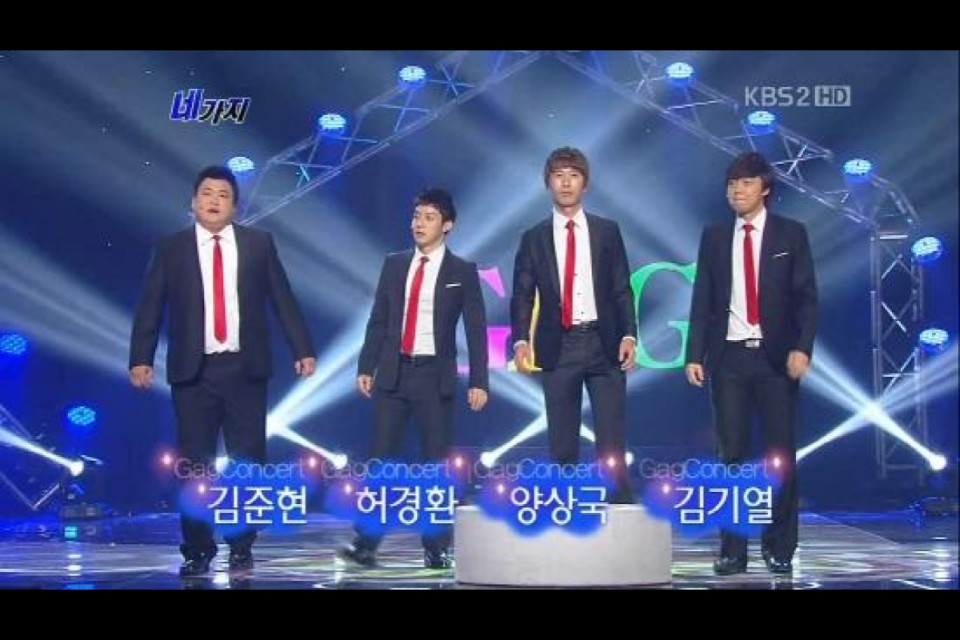
Gag Concert once felt like the full stop at the end of Sunday night. When the show ended, the weekend seemed to end with it, and the next day, its catchphrases passed through schools and offices. Yet at some point, the same program began to be called both “not funny” and “uncomfortable.” The rise and fall of Gag Concert is less a report card for a single show than a record of how Korean society changed what it laughs at.
First, a Word About “Gagman”
Before talking about Gag Concert, there are two terms to clarify: gagman (개그맨) and gagwoman (개그우먼).
For many years in Korea, these were the familiar terms for people who made audiences laugh on television. Today, the gender-neutral word comedian is also widely used, but during Gag Concert’s heyday, gagman and gagwoman were far more common.
The expressions look English. English does have the word gag, meaning a joke or a comic bit. But in English-speaking countries, the profession is usually called comedian. The Korean term gagman is less a direct borrowing from English than a word that took root within Korean broadcasting culture.
The name Gag Concert works in much the same way. Koreans shortened the program’s title to Gaegon (개콘). Although “concert” appears in the name, it was not a music show. It was a live-audience sketch comedy program that presented a series of short comedy segments before a studio audience and included their reactions in the broadcast.
Laughter, applause, and even brief moments of awkwardness all became part of the stage. Gag Concert introduced that format to a wider audience, and sustained it longer, than any other program in Korea.
1999: From the Comedy Stage to the Television Studio
Gag Concert began in 1999. This was not yet an era when people scrolled through short videos on YouTube or smartphones. To watch a popular program, viewers had to wait in front of the television at its scheduled time.
Early Gag Concert was a broadcast, but it also felt like a live performance. Comedians performed directly in front of a studio audience, whose reactions went straight into the program. When the laughter came, a segment came alive; when the response was weak, the emptiness showed. The show was prerecorded, but it retained the tension of a stage performance.
Gag Concert did not grow solely inside a television studio. It also grew out of comedy performed for audiences in venues around Daehangno before moving onto television. The energy of the stage met television’s reach, opening major opportunities for comedians.
When one segment took off, a comedian’s name and face could become widely known almost overnight. Simply appearing on television could change a career. Kim Jun-ho, Kim Dae-hee, Lee Soo-geun, Kim Byung-man, Shin Bong-sun, Kang Yu-mi, and Ahn Young-mi all became familiar to the public through Gag Concert. Some became stars through a single segment, while others came to represent an era through one catchphrase.
That was why Gag Concert was more than a popular entertainment show. For many comedians, it was quite literally a gateway to success.
The 2000s: The National Variety Show That Defined Sunday Nights
In the 2000s, Gag Concert held a special place in Korean entertainment. People watched it on Sunday nights. It was a time when families still gathered around the television, and the program came to feel like a signal that the weekend was ending.
Korean has an expression, gukmin yeneung (국민 예능), or “national variety show.” It does not literally mean that every person in the country watched it. Rather, it describes an entertainment program that was widely known and frequently discussed. The phrase suited Gag Concert in the 2000s.
Many people also remember the mood when the show ended. They had spent the broadcast laughing, but when the closing music began, it somehow felt like a return to reality. Students thought about school the next day, while office workers thought about Monday morning. For some viewers, the end of Gag Concert was both the end of the laughter and the end of the weekend.
Gag Concert also left behind countless catchphrases. A single line from a segment could spread through schools, workplaces, and online comments. When someone imitated a particular way of speaking, those around them immediately knew which segment it came from. Catchphrases escaped the broadcast and entered everyday conversation.
There were many signature segments. Bongsunga School gathered a cast of eccentric characters in the familiar setting of a classroom. We Need to Talk found humor in a quiet, taciturn family. Mabbaki became hugely popular through repeated physical movements and rhythm. The Master drew laughs from performers pretending to carry out absurd skills as though they were real.
By then, Gag Concert was more than a comedy program. It had become something close to a shared language. People watched the same scenes at the same time and talked about them again the next day. It was an era when television comedy flowed directly into everyday conversation.
The Live-Audience Comedy Scene Expands Alongside People Looking for a Laugh
As Gag Concert became popular, the field of live-audience comedy expanded. In the 2000s, SBS’s People Looking for a Laugh, commonly shortened in Korean to Utchatsa (웃찾사), also became a major hit.
Utchatsa likewise presented comedy segments before a studio audience. Its atmosphere, however, was somewhat different. If Gag Concert was closer to a family variety show for KBS’s Sunday nights, Utchatsa emphasized a younger, faster style.
The two programs competed and together created a golden age for live-audience sketch comedy. Comedians worked on bolder characters and catchphrases that would stick more easily. Viewers compared which segments were funnier. Broadcasters, too, treated live-audience comedy as a major entertainment genre.
At the time, the route to public recognition was still relatively clear for comedians. They could pass a broadcaster’s open recruitment process, earn a segment on a live-audience comedy stage, and make their name through television. TV remained the center of comedy, and appearing on a television stage meant standing before the public.
But this structure began to falter in the 2010s.
2011: More Choices Arrive
A different current appeared in 2011, when tvN launched Comedy Big League and SNL Korea in succession.
Comedy Big League added the feel of a competition to live-audience sketch comedy. Comedy teams created segments, received evaluations, and competed in rankings. While Gag Concert was closer to the traditional form, Comedy Big League placed competition at the center of its format.
SNL Korea had a different character altogether. As the Korean version of the American program Saturday Night Live, it aired later and adopted a more adult tone. Its rapid parodies of politicians, celebrities, and events in the news also set it apart from Gag Concert.
This did not mean that Gag Concert immediately lost its strength. It still had many widely discussed segments in the early 2010s. Aejeongnam, Praying Mantis Kindergarten, Emergency Committee, Brave Guys, Four Things, and Yellow Sea continued to draw strong responses.
But viewers clearly had more options. Those who wanted sharper parody could watch SNL, while those looking for another style of live comedy could turn to Comedy Big League. The era when Gag Concert stood alone at the center of Korean comedy was slowly passing.
How Smartphones Changed the Speed of Laughter
An even bigger shift arrived after the mid-2010s. Smartphones became part of everyday life, while YouTube and OTT services grew rapidly. OTT services deliver dramas, variety shows, films, and other video content over the internet.
People no longer laughed according to a television schedule. They watched when they wanted and skipped ahead as soon as something stopped being entertaining.
This shift was devastating for live-audience sketch comedy. The format fundamentally needs time. A situation must be established, characters must enter, and repeated lines or actions must build before the laugh arrives. It works best when a segment is watched from beginning to end.
The rhythm is different on a smartphone screen. A video has only seconds to capture attention. Clips cut down to the funniest moment, short and punchy scenes, and videos that can be shared immediately all have an advantage. Longer, slower-building segments could easily feel too slow.
At some point, Gag Concert was no longer competing only with other comedy programs. YouTube Shorts, internet memes, entertainment clips, and short videos from individual creators all became rivals. Viewers no longer needed to wait until Sunday night. A funny video was always available on the screen in their hands.
Around this time, “Have you seen this video?” began to sound more natural than “Did you watch Gag Concert this week?” The basic unit of laughter was shifting from a full television episode to a single clip.
Between the “Oversensitive” Label and Safe Comedy
The media environment was not the only thing changing. Standards for what people found funny were changing too. One term that captures this shift is bulpyeonreo (불편러).
Bulpyeonreo is a mocking term for someone who says a piece of content makes them uncomfortable. It carries the suggestion that the person is being overly sensitive about something trivial. The word often appeared in debates about variety shows and comedy. When someone said, “This joke feels like appearance-based mockery,” “This scene feels sexist,” or “The way it imitates how people from other countries speak makes me uncomfortable,” the response from the other side was often, “There are so many bulpyeonreo these days that you cannot do anything anymore.”
There were practical reasons behind that reaction. Broadcast comedy had indeed become far more cautious than before. Programs on the major broadcast networks, in particular, had to consider stricter standards because several generations might watch them together. Cross the line even slightly, and controversy could follow, forcing producers and performers to apologize. Many viewers felt that comedy had become constrained in such an environment.
Still, not every expression of discomfort could be dismissed as oversensitivity. Older comedy often made easy targets of someone’s appearance, body, speech, gender, age, region, or nationality. Scenes that once passed without much thought can look different over time. When laughter is repeatedly created by putting someone down, there is also a reason to speak about the discomfort it causes.
Gag Concert’s difficulty lay precisely between those positions. If it continued in the old way, it could hardly avoid criticism for dated, demeaning humor. If it tried to avoid every controversy, it was called bland. Viewers had grown tired of comedy that hurt people, but they were also quick to lose interest in comedy that took no risks.
Ultimately, Gag Concert had to discard old forms of laughter while creating new ones. Social sensibilities in Korea were changing, and viewers were becoming more demanding. They wanted comedy to be more careful, yet expected it to be sharper at the same time. Gag Concert gradually lost strength between those contradictory demands.
2020: The Curtain Falls on the Sunday-Night Stage
Gag Concert came to an end in 2020. Familiar faces returned for the final broadcast, and several comedians shed tears. It was the end of one program, but it also looked like the end of an era.
The choices made by the production team, the quality of individual segments, and changes in the cast likely played a role. Some segments no longer had the force they once did, while some attempts failed to keep pace with the times. But it is difficult to explain Gag Concert’s decline as the failure of only one or two people.
Larger changes were underway. Families were less likely to gather in front of the television at the same hour. Comedy was increasingly consumed through short clips. Viewers’ sensibilities had changed. The path to becoming a famous comedian had also expanded beyond the broadcasters.
Nor was the problem unique to Gag Concert. Utchatsa lost momentum earlier, and although Comedy Big League kept the live-audience comedy stage alive for a time, it too struggled to maintain its former influence. Live-audience sketch comedy itself no longer held the power it once had.
Saying that Gag Concert ended simply because it became less funny is not enough. The stage on which it had stood was disappearing. Gag Concert had once been like a living room where everyone laughed together. That shared living room is now dispersed across smartphone screens, YouTube clips, streaming programs, and individual algorithms.
2023: The Stage Opens Again
Gag Concert returned in 2023. But its revival did not mean going back to the past.
The old Gag Concert had been the national variety show that defined Sunday nights. It would be difficult for the current version to reclaim that exact position. The times have changed. People are no longer accustomed to waiting for one program at the same hour each week. Many encounter it first through clips rather than the original broadcast.
For a long time, older videos were also more likely to attract engagement on YouTube than new segments. The humor in those older segments had already proved itself, and they also carried nostalgia. Comments such as “This was when the show was really funny” and “I still remember this catchphrase” kept appearing. Before seeking out the new Gag Concert, people first returned to the version they remembered.
That does not mean the present-day Gag Concert has no value. More recently, short clips from new broadcasts have gradually begun appearing in recommendation feeds as well. It is now difficult to judge success or failure by a single television rating.
The way forward for today’s Gag Concert does not lie in recreating its past glory exactly. Scenes that work as short clips, reactions that continue in the comments, viewers who return on their phones, and a stage where new comedians can become known—these elements have become more important.
Gag Concert can no longer command everyone’s Sunday night. Instead, it is trying to find a way to survive again in a changed environment. It is less a program of the past than one carrying its past while trying to adapt to the present.
What Gag Concert Left Behind
Gag Concert contains many of the defining moments of Korean comedy. It nurtured countless comedians, shaped Sunday nights in Korea, and left behind catchphrases and characters. It is difficult to discuss Korean popular culture without it.
At the same time, Gag Concert also left behind uncomfortable scenes. Some forms of humor began to look dated with time, and some moments became harder to laugh at without unease. People grew tired of jokes that made targets of those with less power, yet they also quickly grew bored with safe comedy that touched nothing at all. Meanwhile, the viewers who once sat together in front of the television scattered to their own screens.
That is why the story of Gag Concert is not simply a story of failure. It is closer to the story of how Korean society changed its laughter. What was once funny has now become a question, and what people laugh at naturally today may one day look unfamiliar again.
Following Gag Concert through time reveals what people in Korea laughed at, and what they eventually stopped laughing at. Gag Concert is both a former national variety show and a comedy program still looking for a new place in a changed environment. That change itself remains a scene in the history of Korean popular culture.
- Park Hanbin