Why Is Driving in Busan So Difficult?
How Busan’s mountains, sea, wartime refugee history, port logistics, and hard-to-read roads shaped the way people drive in the city.
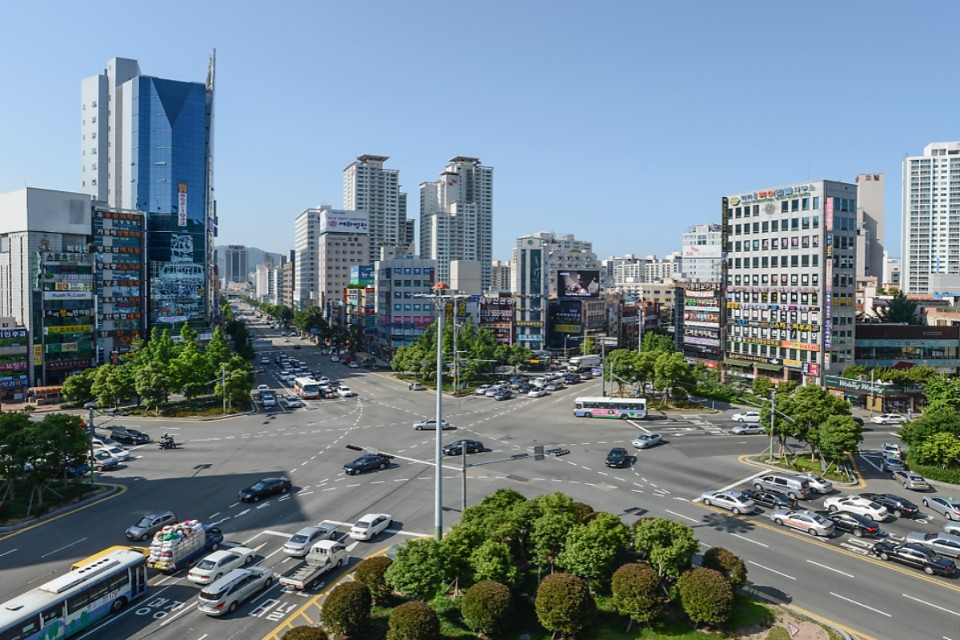
When you drive in Busan for the first time, choosing the wrong lane just once can send you down a completely different road. Signs come into view late, lanes suddenly disappear, and the car beside you moves over as though its driver already knows what comes next. Perhaps Busan’s reputation for rough driving began with the roads before it began with the people.
A City Where You Learn Too Late Which Lane to Be In
Many people driving in Busan for the first time encounter a similar moment. The navigation system tells them to keep right, but the right-hand lane is already packed. It seems as though a gap might open if they wait a little longer, but the road splits before it does. Failing to move over by a single lane can leave them heading farther and farther from their destination.
Driving in Busan does not feel difficult simply because there are many cars. The shape of the roads is often different from what drivers expect. A lane may suddenly end, and it may become clear only at the last moment where each lane leads. In some places, road signs and traffic lights are also difficult to take in at a glance.
For someone new to the city, roads like these can feel unforgiving. By contrast, people who have driven in Busan for years are familiar with the flow. Experience tells them whether the car ahead is about to merge, where the neighboring lane will begin to back up, and at which point they need to move over in advance.
That difference is what makes driving in Busan feel unfamiliar. To understand the habits of Busan drivers, we first need to look at why the city’s roads came to take this form.
A City Where Wide, Straight Roads Were Hard to Build
Busan grew between mountains and the sea. Mountains rise throughout the city, while the sea forms a boundary along one side. Rivers, the port, hills, and valleys divide the city into separate pieces as well. These were difficult conditions for laying straight roads across broad, flat ground.
Busan’s roads curve around mountains and follow the coastline. Tunnels cut through some places, while bridges span others. Roads such as the Busan Harbor Bridge—stretching across the water to link the port, an island, and the city center—create scenes that feel distinctly Busan. They are impressive, but they are not easy roads to navigate.
In a city like this, drivers have to make decisions more often. Roads do not simply continue straight ahead. They bend, merge, and split off without much warning. Drivers may need to change lanes as soon as they leave a tunnel, or choose a direction within seconds at a large intersection.
This is where the sense that driving in Busan is difficult begins. From the beginning, this was terrain where spacious, simple roads were hard to build.
When Life Came Before Roads
Any discussion of Busan’s roads must include the Korean War. During the war, Busan served for a time as South Korea’s wartime capital. This means the functions of the capital were temporarily relocated there because of the conflict.
Many people made their way to Busan during that period. People who had lost their homes, been separated from family, or needed somewhere to begin again gathered in the city. They were known as piranmin (피란민), or people displaced by the Korean War—those who had fled to another place to escape war or disaster.
The city did not have time to take in so many people gradually. It could not grow in an orderly sequence—first building broad roads, then putting up homes, and finally organizing the surrounding neighborhoods. People had to live somewhere first. Homes appeared on hillsides and in empty spaces, and roads were laid later, following the lives already there.
Seen through today’s eyes, many of these roads look strange. There are alleys that turn abruptly, narrow roads running up hills, and passages barely wide enough for a single car. Yet no one set out to build them that way. There was a time when survival came before planning, and that time left its shape on the city.
Sanbokdoro: A Scene from Old Busan
Busan’s sanbokdoro (산복도로), hillside roads built along the city’s slopes, are among the clearest expressions of this history. Many neighborhoods around the old city center cluster on hillsides, and these roads connect them.
For travelers, these roads can offer beautiful views. From high above, the sea and city appear together, while old houses and alleys create an atmosphere that feels unmistakably Busan. For the people who live there, however, these are everyday roads they must travel up and down. They are both scenery and everyday life.
These hillside roads are not the whole story of driving in Busan. No single type of road can explain why driving here is difficult. Still, they offer a vivid picture of why Busan’s roads could not easily spread out across flat, open ground.
The way people drive in Busan was shaped by many such scenes layered over time. Hillside roads, tunnels, bridges, port roads, and complicated intersections have all changed the experience of driving in the city.
When Roads Speak Too Late, Drivers Act Fast
Drivers are constantly reading information from the road. They need to know in advance which lane to be in, when to exit, and where the road will split. A good road gives them that information early. Then drivers can prepare calmly.
The problem is a road that speaks too late. Warnings that a lane is ending may appear late, signs may be hard to spot, and traffic lights may be placed in positions or at angles that are hard to interpret. Arrows and guidance lines painted on the pavement can be confusing as well.
These lines and arrows on the pavement are road markings. They tell drivers whether a lane continues straight or turns left, and which direction they should follow. When the markings are unclear, drivers begin to judge by the movement of the car ahead rather than by the signs.
At first glance, a car may seem to cut in suddenly. But once you see how the road unfolds, it may become clear that the driver was not trying to force their way in from the start. Sometimes the road gives information so late that there is no choice but to move at the last moment.
The road also affects how easy it is to yield. Letting others go first is good driving practice. On some roads, however, a driver who keeps yielding may never reach the lane they need and may end up heading in the wrong direction instead. Yielding becomes easier when drivers can trust that waiting will still get them where they need to go. Many of Busan’s older roads did not inspire that confidence.
Learning to Squeeze Into a Gap
Korean has an expression, bijipgo deureogada (비집고 들어가다), which means to squeeze into a narrow gap. There are moments while driving in Busan when the phrase comes to mind. Even when the space is not quite wide enough, a driver may spot a small opening and move in.
To someone seeing it for the first time, this can look frightening and rushed. But people who have driven in Busan for years are somewhat accustomed to these movements. Experience helps them anticipate whether the car beside them will merge, whether the car ahead will change lanes, and where traffic is likely to bunch up.
This does not mean traffic rules can be ignored. Rather, it suggests that on many stretches of road in Busan, official guidance alone has not always been enough. Drivers have had to read not only signs and lane markings, but also the feel of the road and the movements of other cars.
Drivers unfamiliar with the city do not yet know this grammar. It can be hard to understand why a lane narrows here, why the car ahead is merging now, or why the car beside them did not make room earlier. That is why driving in Busan can feel rougher and less predictable.
Busan drivers have adapted to complicated roads. Drivers new to the city have not yet learned the same habits. The gap between the two is what makes driving in Busan feel so unfamiliar.
The Weight of a Port City
Busan is a port city. The work of a port does not end at the water’s edge. Goods unloaded from ships are loaded onto trucks and carried along the roads, while cargo bound for ships also travels through the city toward the port.
This movement is known as port logistics. Busan’s roads carry more than commuters in cars and buses. Container trucks, freight vehicles bound for warehouses and factories, and other large vehicles moving around the port all share the road.
The Port of Busan accounts for a major share of South Korea’s logistics. Huge numbers of containers pass through it, and some of that movement connects directly to the city’s roads. Busan’s roads serve everyday life, but they also serve industry.
In this compact city, cars, buses, taxis, motorcycles, and freight trucks all move together. Mountains, tunnels, bridges, and intersections are layered on top of that. The tension of driving in Busan is also closely tied to its character as a port city.
Newly Planned Roads Feel Different
Not every road in Busan feels the same. Driving through the older city center is different from driving through districts planned more recently.
Haeundae New Town was developed as one of Busan’s best-known planned urban districts. In a planned district, housing, roads, parks, schools, and other facilities are mapped out in advance. As a result, its roads and blocks are easier to read than those in the older city center.
Haeundae is not perfect, of course. Planned districts also age over time, and new traffic problems emerge. Haeundae New Town itself has reached a stage where its aging infrastructure needs to be reassessed and renewed.
Even so, after passing through an older hillside neighborhood or the complicated streets of the old city center, entering an area such as Haeundae or Centum City can change the rhythm of driving. The roads are wider, the lanes clearer, and the intersection layouts relatively easy to read.
This is more than a simple difference in road design. Driving habits are not only about drivers. When roads change, driving changes too. If roads provide information early, lanes connect naturally, and signs are easy to see, drivers can move with less urgency.
When Roads Become More Driver-Friendly, Driving Changes Too
Busan is still working on its roads. The city is improving older road layouts, redesigning complicated intersections, and planning new road networks to link major areas. Efforts are also continuing to improve signs, traffic signals, and traffic information systems.
These changes are not simply about making roads wider. They are about helping drivers understand the road sooner. When drivers can tell in advance where they need to go and take the right route without having to merge suddenly, driving becomes a little less hurried.
Driving habits in Busan can change in the same way. This is not because people suddenly become different, but because the environment in which they move changes. When roads become a little more driver-friendly, drivers no longer need to squeeze into gaps as often. They begin to trust that waiting will still get them where they need to go.
The idea that Busan is difficult to drive in sometimes sounds like a simple joke. But behind that comment lie the city’s geography and history, its industries, and its road infrastructure. Limited space between the mountains and the sea, neighborhoods that expanded rapidly after the war, port logistics, and roads that provide information too late all helped shape the way people drive in Busan.
Some cities learn order on broad roads. Others learn to make quick decisions on narrow, complicated ones. For a long time, Busan was closer to the latter.
But the roads are changing. When roads change, driving changes too. And when driving changes, how people see Busan may change a little as well.
- Park Hanbin